- Published on
From Detection to Learning: Seven Capabilities of Industrial AI in Process Monitoring
- Authors

- Name
- Ajeet Kumar Singh
The Diesel Pump
Growing up in an Indian village in the early 2000s, diesel water pumps were everywhere.
They were not just machines used for irrigation. For us children, they were part of everyday village life.
During the scorching summer afternoons, when the fields were being irrigated, the water pump would become our favourite place to cool down. Many farms had a small water tank or pond-like structure connected to the irrigation setup.
And for us, that was an invitation.
Of course, we couldn't simply jump in.
We had to ask permission.
We would find the farmer who owned the pump and ask, sometimes repeatedly, if we could use the tank to take a bath. Once permission was granted, the real fun began.
We would jump into the cold water, splash each other, and spend what felt like hours trying to escape the heat of the summer afternoon.
But there was one thing we all knew about those pumps:
Sometimes, they simply stopped.
And when the pump stopped, everything stopped.
The water stopped flowing.
The tank slowly stopped filling.
The fun was over.
That was when the adults would gather around the machine.
The first thing someone would do was listen.
The diesel engine had its own familiar rhythm. When everything was working normally, you could almost recognize the sound without looking at it.
But when something was wrong, the sound changed.
"Does it sound different?"
Someone would check the diesel level.
Another person might look at the engine oil, the belt, or the pump.
Someone would check whether the water was still flowing properly and whether the pressure had started dropping.
They might touch the engine and notice that it was running hotter than usual.
Someone would pull the starter again and listen carefully to how the engine responded.
And then the questions would begin.
"When did it stop?"
"Was the water pressure already getting weaker?"
"Was the engine making that strange sound earlier?"
"Did it start normally today?"
These weren't random checks.
They were clues.
The person who had worked with that pump for years had seen its normal behaviour hundreds of times.
He knew how it sounded when it was healthy. He knew how it vibrated. He knew what the engine felt like when it was getting too hot. And he remembered what had happened the last time the pump behaved like this.
He had built a mental picture of how the machine behaved.
Experience.
That was the real diagnostic system.
There was no digital dashboard. There was no automated explanation. There was simply a person who had spent years observing the same machine — and that experience allowed him to connect the clues.
A change in engine sound. A drop in water pressure. An unusually hot engine. A change in starting behaviour.
Individually, each clue might mean very little. Together, they told a story.
And based on that story, he could often say:
"This is probably the problem. Check this first."
The pump itself was not intelligent.
The intelligence was in the relationship between the machine and the person who understood it — someone who had learned to notice deviations, connect clues, remember previous failures, and decide what to check next.
That is the capability industrial AI is trying to replicate at scale.
And that leads to a much bigger question.
What happens when we try to scale that kind of experience to an entire plant?
That is where the story of industrial AI begins — not with autonomy or agents, but with a machine behaving differently, someone noticing, and a system trying to help connect the clues.
From listening to one diesel pump... to listening to an entire plant.
From the Village Pump to the Industrial Plant
The diesel pump was simple. One engine, one pump, a few physical signals, and one person who had spent years working with it.
Now imagine the same problem inside a modern industrial plant.
The machine is no longer one diesel pump.
There may be hundreds or thousands of pieces of equipment operating simultaneously.
Pumps. Compressors. Motors. Heat exchangers. Reactors. Valves. Turbines. Conveyors. Storage systems.
Each one generates information continuously.
Temperature changes. Pressure changes. Flow rates. Vibration patterns. Energy consumption. Valve positions. Equipment status. Alarm events. Maintenance records. Production conditions.
And unlike the village pump, the industrial engineer cannot simply stand beside every machine and listen.
The scale has changed completely.
The Fundamental Problem Has Not Changed
At first glance, the village pump and the industrial plant seem worlds apart.
But the underlying question is surprisingly similar.
The pump stops. Why?
A reactor temperature begins to rise. Why?
The pump's water flow decreases. Why?
A compressor begins vibrating differently. Why?
A production unit starts behaving differently from normal. What changed?
The fundamental challenge is still diagnosis.
The difference is the amount of information involved.
With the village pump, an experienced person might have only a handful of clues.
With an industrial plant, an engineer may have millions.
And more data does not automatically mean more understanding.
In fact, it can create a new problem.
Information becomes fragmented.
The temperature data may exist in one system. Equipment history may exist somewhere else. Maintenance records may be stored in another application. Operating procedures may sit inside document repositories. Historical incidents may be buried in reports. Process diagrams may be maintained separately.
And the engineer may have to connect all of these pieces mentally while the process is still running.
One Machine vs. An Entire Plant
The village pump had a simple relationship:
One machine → a few signals → experienced human → diagnosis
The industrial plant looks very different:
Thousands of machines → millions of signals → fragmented knowledge → overloaded humans
The challenge is no longer simply collecting data.
Industrial plants already collect enormous amounts of data.
The challenge is turning that data into context, understanding, and decisions.
And that is the scale at which AI begins to become interesting.
The Reactor Unit 3 Incident
It is 2:17 a.m.
Most of the plant is running normally.
Then an alert appears on the control room screen:
Reactor Unit 3 — Temperature Deviation Detected
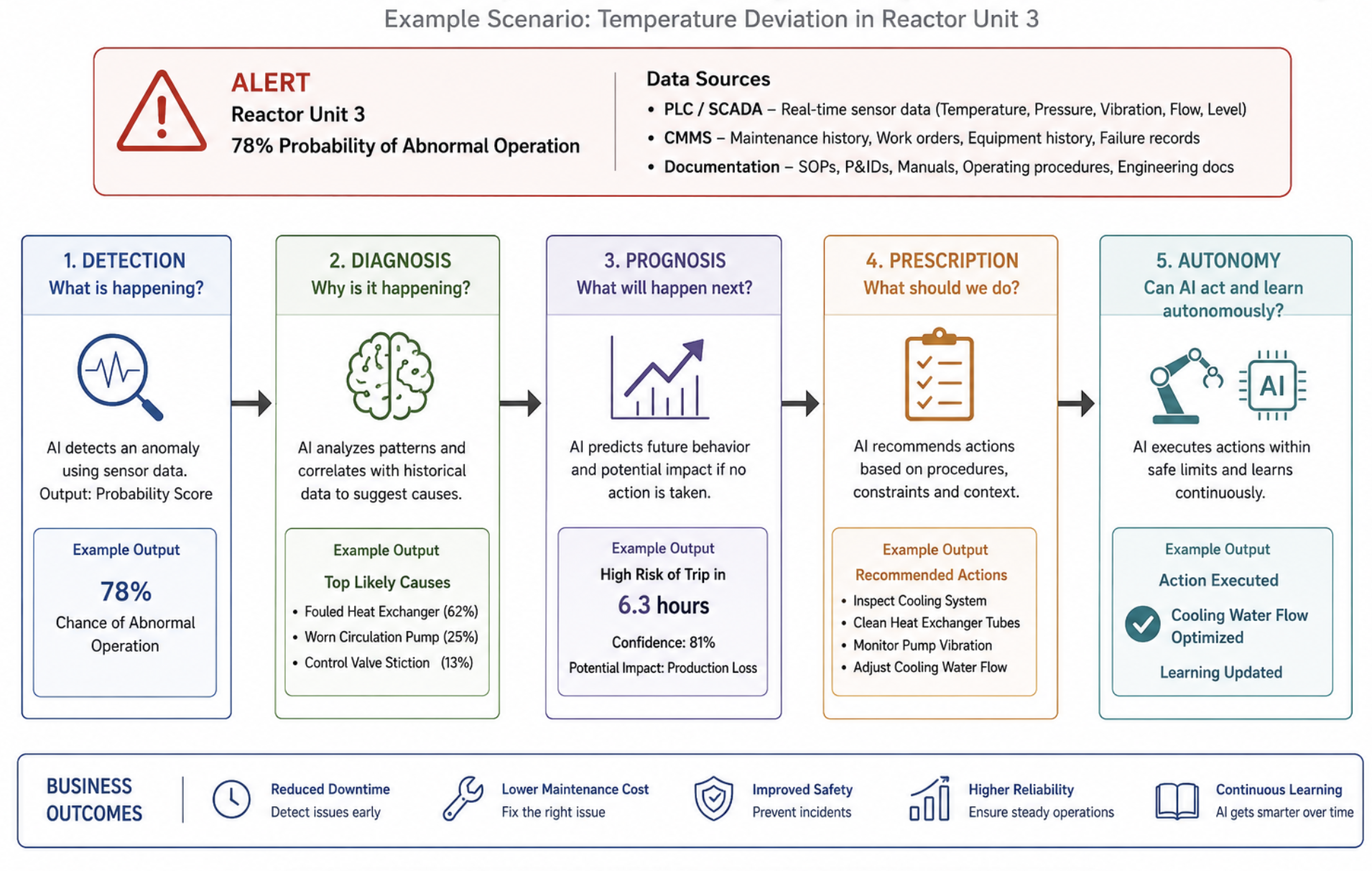
The reactor temperature has started moving away from its normal operating range.
The anomaly-detection system has identified the change and assigns a 78% probability of abnormal operation.
Note: This article assumes an anomaly detector already exists and has fired. The seven capability layers explore what happens after detection — how the system helps the engineer understand, investigate, and respond. Detection itself (statistical process control, threshold monitoring, ML-based anomaly scoring) is a separate and important topic.
The operator sees the alert.
But the alert tells him only one thing:
Something is different.
It does not tell him why.
So the questions begin.
What changed?
Why is the temperature rising?
Is this just a temporary fluctuation, or is something beginning to fail?
How serious is it?
What should we check first?
And perhaps the most important question:
What happens if we do nothing?
The operator starts investigating.
The current temperature is higher than expected, but temperature alone does not explain the cause.
Maybe production load has increased.
Maybe the cooling system is becoming less effective.
Maybe a pump is beginning to degrade.
Maybe a heat exchanger is losing efficiency.
Maybe the sensor itself is behaving incorrectly.
At this point, all of these are possibilities.
The system has detected the symptom.
It has not yet diagnosed the problem.
And this is exactly where the difference between detection and understanding becomes important — the same lesson the diesel pump taught us.
The engineer facing Reactor Unit 3 has the same fundamental problem — but on a completely different scale.
Instead of a handful of physical clues, there may be thousands of signals.
Instead of one machine, there may be an entire production process.
Instead of one person's memory, the relevant knowledge may be distributed across years of maintenance records, operating procedures, historical incidents, equipment data, and engineering documentation.
But the question remains the same:
Why did the machine behave differently?
This single incident becomes our running example for the rest of the journey.
We will follow Reactor Unit 3 through each stage of AI evolution.
First, the system must find relevant information. If an engineer searches for "reactor temperature anomaly," can the system find documents that use completely different terminology?
Then it must understand the context. Can it connect the current event with relevant operating procedures, previous incidents, and equipment history?
Then it must reason across evidence. Can it recognize that a gradual reduction in cooling flow, combined with a rising reactor temperature and a previous pump issue, may point toward a common cause?
Then it must recommend what to do next. Can it identify the most useful checks and prioritize them?
Then comes coordination. Can the system help initiate an inspection, check spare-parts availability, notify the appropriate team, and record the event?
And finally, after the incident is resolved: Can the system learn from what actually happened?
Perhaps the investigation discovers that the cooling pump had a developing mechanical problem. Perhaps the heat exchanger was fouled. Perhaps the sensor was faulty. Perhaps the original hypothesis was wrong.
That outcome matters. Because the next time a similar pattern appears, the system should not simply repeat the same investigation. It should have more context. More evidence. More experience.
And eventually, perhaps, it should recognize the pattern before the temperature deviation becomes an alarm.
That is the journey we are about to explore.
The Reactor Unit 3 incident starts with a simple alert:
Something is wrong.
The first generation of systems could stop there. The next generation can ask:
What information is relevant?
Then:
What does it mean?
Then:
Why is it happening?
Then:
What should we do?
Then:
What did we learn?
And eventually:
Can we see it coming before it happens?
One incident. One reactor. One evolving AI system. And seven capability layers.
Let's start with the simplest question: When an engineer knows something is wrong, where does the system look for answers?
The Seven-Stage Journey at a Glance
Each stage is an attempt to reproduce a specific capability that the experienced farmer had when standing beside his diesel pump.
| What the farmer could do | AI stage that attempts to replicate it |
|---|---|
| Recognise familiar words and documents about his machine | 1. Keyword Search |
| Recognise different descriptions of the same problem | 2. Semantic Understanding |
| Recall relevant experience quickly, across many past events | 3. Vector Indexing (infrastructure for scale) |
| Combine retrieved knowledge into context for the current situation | 4. RAG — Contextual Guidance |
| Connect multiple weak signals into one coherent explanation | 5. Cross-System Reasoning |
| Coordinate what happens next — who to call, what to check, what to log | 6. Operational Coordination |
| Remember what happened, improve future judgment from each resolved event | 7. Organisational Learning |
The technologies — embeddings, vector indexes, RAG, agents — are all in service of that single goal: making those capabilities available at the scale of an entire plant.
We will walk through each layer using the same Reactor Unit 3 incident, allowing us to see how the capability evolves step by step.
1. Keyword Retrieval: The Baseline and Its Limits
Capability added: The system can search a knowledge base. Engineers can type a query and get a list of matching documents.
Human capability being reproduced: The farmer could recognise familiar words in documents he had read before.
It is 2:17 a.m. The Reactor Unit 3 alert is on screen.
The engineer opens the plant's knowledge management system and types:
reactor temperature anomaly
The system searches.
It scans thousands of Standard Operating Procedures, maintenance manuals, Process and Instrumentation Diagrams, and incident reports stored in the Computerized Maintenance Management System.
It returns documents containing those exact words.
And it misses everything else.
The Problem with Exact Matching
Keyword search is fast and simple. It works exactly as described: if the document contains the words you typed, it appears in the results. If it does not, it does not.
The problem is that industrial knowledge is not consistent in its language.
The same operational condition — a reactor running too hot due to a cooling problem — might be documented across your organization as any of the following:
- "reactor temperature anomaly" — Process Engineering
- "thermal excursion in ammonia synthesis loop" — Operations
- "heat exchanger fouling indication" — Maintenance
- "catalyst bed overheating risk" — Safety Engineering
- "process temperature drift beyond setpoint" — Control Systems
- "cooling circuit degradation" — Equipment team
A keyword search for "reactor temperature anomaly" will return documents from the first category.
It will miss every document from the other five — even though they may contain exactly the information the engineer needs right now.
What the Code Looks Like
import os

def keyword_search_cmms(query, knowledge_base_path):
    """
    Basic keyword search across plain-text documentation.
    This example uses .txt files for simplicity.
    Real implementations use document parsers for PDF/DOCX content.
    """
    results = []

    for file_name in os.listdir(knowledge_base_path):
        if not file_name.endswith(".txt"):
            continue

        file_path = os.path.join(knowledge_base_path, file_name)
        try:
            with open(file_path, "r", encoding="utf-8") as f:
                content = f.read().lower()

            if query.lower() in content:
                results.append({
                    "filename": file_name,
                    "system": "CMMS" if "maint" in file_name else "SOP",
                    "content_preview": content[:200] + "..."
                })
        except:
            continue
for result in search_results:
    print(f"- {result['filename']} ({result['system']})")
This would successfully find a document like:
Standard Operating Procedure: Reactor Unit 3 Temperature Management
If a reactor temperature anomaly occurs in the ammonia synthesis loop,
operators must verify PLC sensor readings, inspect coolant circulation
pump status, and check heat exchanger fouling before initiating
emergency shutdown procedures.
But it would return nothing for a document titled "Thermal Excursion Mitigation — Ammonia Synthesis Loop", even if that document contains the most relevant procedure for exactly this situation.
What the Engineer Experiences
The engineer searches once. Gets partial results.
Searches again with different words. Gets different partial results.
Searches a third time. Still not sure they have the full picture.
Meanwhile, the reactor temperature is continuing to rise.
This is the core limitation of keyword search in an operational setting: it is not built for the urgency of the moment. It rewards whoever typed the right words at the time of authoring the document.
Why This Matters in Industrial Environments
| Problem | Impact during a live operational incident |
|---|---|
| Terminology inconsistency across departments | Engineer must guess which words the original author used |
| No connection between related concepts | Relevant procedures in other documents are invisible |
| Multiple searches required | Time lost while the process continues to deviate |
| Knowledge fragmentation across systems | Engineer must check CMMS, SOPs, and P&IDs separately |
The Verdict
Keyword search is not a failure. It was the only practical option for many years, and it still works well for simple, controlled queries where terminology is consistent.
But in a large industrial plant, with dozens of engineering disciplines, decades of documentation, and a live anomaly demanding attention — it is not enough.
The engineer does not need a system that finds documents containing the words they typed.
They need a system that understands what they are looking for — even when the words are different.
Up next: What if the system could understand that "thermal excursion" and "reactor temperature anomaly" mean the same thing — without being told? That is exactly what semantic search makes possible.
2. Semantic Retrieval: Moving Beyond Exact Matching
Capability added: The system can now find relevant documents even when the engineer's words don't match the author's words — searching by meaning instead of by exact text.
Human capability being reproduced: The farmer recognised the same problem even when it presented differently — a different sound, a different symptom, a different part failing.
The engineer tries a second search: "thermal excursion."
Different results. Some overlap. Some new.
A third search: "cooling system failure."
More results. More reading. Still no complete picture.
Every minute spent trying different search words is a minute the reactor temperature is continuing to rise.
This is the problem that semantic search is designed to solve.
The Core Idea: Search by Meaning, Not by Words
Keyword search asks: does this document contain these exact words?
Semantic search asks: does this document discuss the same concept?
To make that distinction, AI systems convert text into numerical vectors — dense representations that encode meaning rather than just words. Documents discussing similar concepts tend to end up closer together in this vector space, regardless of the exact words used.
A query for "reactor temperature anomaly" may retrieve documents such as:
- "thermal excursion in ammonia synthesis"
- "heat exchanger fouling indication"
- "catalyst bed overheating risk"
Depending on the embedding model and how the documents were written, these may score as semantically similar — because they share vocabulary from the same domain and context.
Semantic search finds potentially relevant evidence based on linguistic similarity. It does not establish relevance, causality, or factual correctness. The distinction between retrieval and reasoning becomes important in Stage 5.
from sentence_transformers import SentenceTransformer
import numpy as np
from sklearn.metrics.pairwise import cosine_similarity

def semantic_search_industrial_docs(query, documents):
    """
    Semantic search across industrial documentation using sentence transformers
    Finds conceptually related documents regardless of exact terminology
    """
    # Load industrial-trained or general technical model
    model = SentenceTransformer('all-MiniLM-L6-v2')

    # Convert query and documents to vector embeddings
    query_embedding = model.encode([query])
    document_embeddings = model.encode(documents)

    # Calculate semantic similarities using cosine similarity
    similarities = cosine_similarity(query_embedding, document_embeddings)[0]

    # Return documents ranked by semantic relevance
    results = []
### What the Code Looks Like

```python
from sentence_transformers import SentenceTransformer
from sklearn.metrics.pairwise import cosine_similarity
import numpy as np

# Note: all-MiniLM-L6-v2 is a general-purpose model used here for illustration.
# A production system would evaluate domain-specific or fine-tuned models.
def semantic_search(query, documents):
    model = SentenceTransformer('all-MiniLM-L6-v2')
    query_embedding = model.encode([query])
    doc_embeddings = model.encode(documents)
    similarities = cosine_similarity(query_embedding, doc_embeddings)[0]
    return sorted(zip(documents, similarities), key=lambda x: x[1], reverse=True)

documents = [
    "Reactor Unit 3 Temperature Anomaly Response Protocol",
    "Ammonia Synthesis Loop Thermal Excursion Procedures",
    "Heat Exchanger Fouling Detection and Cleaning Standards",
    "Process Temperature Deviation Analysis Methods",
    "Catalyst Bed Overheating Prevention Guidelines",
    "Cooling System Malfunction Early Warning Indicators",
]

results = semantic_search("reactor temperature anomaly", documents)
for doc, score in results[:4]:
    print(f"{score:.3f}  {doc}")
What the Engineer Sees Now
0.847  Reactor Unit 3 Temperature Anomaly Response Protocol
0.782  Ammonia Synthesis Loop Thermal Excursion Procedures
0.721  Process Temperature Deviation Analysis Methods
0.695  Catalyst Bed Overheating Prevention Guidelines
With one search — "reactor temperature anomaly" — the system returns documents that use completely different terminology but describe the same situation. The engineer no longer needs to guess which words the original author used.
The Verdict
Semantic search is a significant step forward. It solves the vocabulary problem that made keyword search so fragile under pressure.
But there is a new challenge. A plant's knowledge base is not seven documents. It may be hundreds of thousands. Comparing the query vector against every single document becomes slow — and under operational pressure, slow is a problem.
Up next: Semantic search solves the vocabulary problem. But what happens when the knowledge base grows to millions of documents? Speed becomes the new challenge — and that is where vector indexing changes everything.
3. Scalable Retrieval Infrastructure
Capability added: Semantic search becomes fast enough to use in real operational conditions at industrial scale. This is an engineering problem, not an intelligence one — but without solving it, the intelligence in Stage 2 is impractical.
Human capability being reproduced: The farmer could recall relevant experience quickly, without needing to pause and search through years of memory. At industrial scale, the system needs to do the same across millions of documents.
Semantic search works. One query, conceptually relevant results, regardless of terminology.
But there is a practical problem.
A plant's knowledge base does not contain seven documents. It may contain 500,000 — every maintenance report ever filed, every incident log, every operating procedure, every equipment data sheet across decades.
With semantic search, every query requires comparing the query vector against every stored vector — a naïve brute-force approach that works for small collections but becomes expensive at scale.
- 1,000 documents → manageable
- 100,000 documents → noticeably slow
This is the problem that approximate nearest-neighbour (ANN) indexing solves.
The Idea: Exact Search vs. Approximate Nearest-Neighbour
A naïve implementation (like IndexFlatL2 in FAISS) compares the query vector against every stored vector — exact but slow at scale. Approximate nearest-neighbour (ANN) indexes such as IVF and HNSW trade a small amount of recall for dramatically lower latency by avoiding the full scan.
Embeddings make meaning searchable. ANN indexes make that search fast at scale.
FAISS is one widely used library that supports both exact and approximate strategies.
What the Code Looks Like
import faiss
import numpy as np
from sentence_transformers import SentenceTransformer

# Note: all-MiniLM-L6-v2 is a general-purpose model used here for illustration.
model = SentenceTransformer('all-MiniLM-L6-v2')

documents = [
    "Reactor Unit 3 Temperature Anomaly Response Protocol",
    "Ammonia Synthesis Loop Thermal Excursion Procedures",
    "Heat Exchanger Fouling Detection and Cleaning Standards",
    "Cooling System Malfunction Early Warning Indicators",
    "Catalyst Bed Overheating Prevention Guidelines",
]

doc_vectors = model.encode(documents).astype("float32")

# IndexFlatL2: exact brute-force search. Accurate but slow at large scale.
# For large corpora, replace with IndexIVFFlat or IndexHNSWFlat (ANN indexes).
dimension = doc_vectors.shape[1]
index = faiss.IndexFlatL2(dimension)
index.add(doc_vectors)

query_vector = model.encode(["reactor temperature anomaly"]).astype("float32")
D, I = index.search(query_vector, k=3)

print("Top results:")
for rank, idx in enumerate(I[0]):
    print(f"{rank + 1}. {documents[idx]}")
Illustrative Python.
IndexFlatL2is suitable for small collections. For large-scale production use, ANN indexes (IVF, HNSW) are more appropriate.
Indexing Strategies: Speed vs. Accuracy
| Strategy | How It Works | Best For |
|---|---|---|
| Flat (Exact) | Compares query against every vector | Small knowledge bases, maximum accuracy |
| IVF (Inverted File) | Groups vectors into clusters; searches only relevant clusters | Medium-large knowledge bases |
| HNSW | Builds a navigable graph; traverses nearest neighbours | Large knowledge bases, lowest latency |
With appropriate indexing strategies such as IVF or HNSW, approximate nearest-neighbour search can dramatically reduce retrieval latency at scale compared to brute-force comparison.
The Verdict
Vector indexing is the infrastructure that makes semantic search viable at industrial scale. Without it, semantic search would be too slow to use under operational pressure.
But fast, relevant documents are still just documents. The next step is to stop returning documents and start generating answers.
Up next: Fast retrieval is powerful. But returning a list of documents still leaves engineers to read, interpret, and connect the dots themselves. What if the AI could do that synthesis for them — generating a specific, actionable response for the exact situation at hand?
4. Contextual Synthesis: RAG in Action
Capability added: Instead of returning documents, the system synthesises them into a specific, actionable response for the current situation — the engineer receives guidance, not a reading list.
Human capability being reproduced: The farmer didn't just remember individual facts. He combined them into a response: "based on everything I know about this machine, here is what I would check first."
The system has retrieved five relevant documents in milliseconds.
The SOP for Reactor Unit 3 temperature deviations. The procedure for adjusting Cooling Pump B flow rates. A historical incident from Reactor Unit 1. A heat exchanger maintenance schedule. A thermal imaging protocol.
Five documents. Each useful. None of them tells the engineer exactly what to do right now, for this reactor, with these readings.
The engineer still has to read all five, mentally combine them, and decide what applies.
RAG — Retrieval-Augmented Generation — changes this.
The Idea: Retrieve, Then Generate
Instead of returning documents, the system:
- Retrieves the most relevant documents using semantic search + vector index
- Combines them into a single context
- Uses a language model to generate a specific, actionable response
The output is not a list. It is a synthesized answer — written for this situation.
What the Code Looks Like
from sentence_transformers import SentenceTransformer
import faiss
import numpy as np

documents = [
    "Reactor Unit 3 Temperature Anomaly Detection and Response SOP",
    "Cooling Pump B Flow Rate Adjustment Procedures",
    "Historical Incident: Thermal Excursion in Reactor Unit 1 and Mitigation",
    "Preventive Maintenance Schedule for Heat Exchangers in Unit 3",
    "Thermal Imaging Protocol for Detecting Hot Spots in Catalyst Beds",
    "Incident Report: Cooling Inefficiency Affecting Reactor Unit 2",
]

model = SentenceTransformer('all-MiniLM-L6-v2')
doc_vectors = model.encode(documents).astype("float32")
index = faiss.IndexFlatL2(doc_vectors.shape[1])
index.add(doc_vectors)

query = "Reactor Unit 3 temperature anomaly — cooling flow decreasing, pressure rising"
query_vector = model.encode([query]).astype("float32")
D, I = index.search(query_vector, k=4)
retrieved = [documents[i] for i in I[0]]

def generate_guidance(retrieved_docs, unit="Reactor Unit 3"):
    """In production, this calls a language model with retrieved docs as context."""
    print(f"\nOperational Guidance for {unit}:")
    print("- Temperature gradient exceeding normal. Monitor every 5 minutes.")
    print("- Check Cooling Pump B flow rate. Compare against SOP baseline thresholds.")
    print("- Review heat exchanger fouling. Schedule thermal imaging if flow reduction confirmed.")
    print("- Historical records show that a similar pattern preceded pump bearing failure.")
    print("  Treat this as a hypothesis to investigate, not a confirmed diagnosis.")
    print("- Notify maintenance if deviation persists beyond 15 minutes.")

print("Retrieved context:")
for doc in retrieved:
    print(f"  - {doc}")

generate_guidance(retrieved)
What the Engineer Receives
Retrieved context:
  - Reactor Unit 3 Temperature Anomaly Detection and Response SOP
  - Cooling Pump B Flow Rate Adjustment Procedures
  - Historical Incident: Thermal Excursion in Reactor Unit 1 and Mitigation
  - Preventive Maintenance Schedule for Heat Exchangers in Unit 3

Operational Guidance for Reactor Unit 3:
- Temperature gradient exceeding normal. Monitor every 5 minutes.
- Check Cooling Pump B flow rate. Compare against SOP baseline thresholds.
- Review heat exchanger fouling. Schedule thermal imaging if flow reduction confirmed.
- Historical records show that a similar pattern preceded pump bearing failure.
  Treat this as a hypothesis to investigate, not a confirmed diagnosis.
- Notify maintenance if deviation persists beyond 15 minutes.
What RAG Adds vs. What Came Before
| Stage | What the engineer receives |
|---|---|
| Keyword Search | Documents containing exact search words |
| Semantic Search + Index | Documents ranked by conceptual relevance |
| RAG | Synthesized, situation-specific actionable guidance |
The Verdict
RAG moves the system from information retrieval to knowledge application.
But there is still a gap. The guidance says: "similar symptom preceded pump bearing failure." That is useful. But the system found it in a historical document — it did not reason across live sensor signals to form its own hypothesis about why the temperature is rising right now.
That requires the next stage.
Up next: Actionable guidance is a step forward. But generating advice for one query at a time is not enough when a real anomaly involves a cooling pump, a heat exchanger, rising pressure, and a temperature sensor — all interacting simultaneously. Understanding the root cause requires reasoning across the entire system at once.
5. Cross-System Reasoning: Understanding the Cause Behind the Anomaly
Capability added: The system can form a hypothesis about why the anomaly is occurring by correlating live sensor data, maintenance history, and past incidents — not just retrieving relevant documents.
Human capability being reproduced: The farmer's most valuable skill was not finding information. It was connecting weak signals — the engine sound, the water pressure, the heat, the memory of last time — into one coherent explanation.
The RAG system told the engineer to check Cooling Pump B flow rate.
The engineer checks. The flow rate is below normal.
But why is the flow rate low?
Is the pump mechanically degrading? Is a valve partially closed? Is there a blockage? Has production load increased?
Each of these would require a different response. The RAG system retrieved documents based on a query. But it did not look at the live sensor streams. It did not check maintenance history. It did not compare current conditions against the baseline. It did not ask whether this combination of signals had appeared before.
That is what multi-system reasoning adds.
The Pattern Hidden Across Systems
When the Reactor Unit 3 signals are examined together across multiple data sources, a pattern emerges that no single system shows alone:
| Data Source | Signal | Observation |
|---|---|---|
| SCADA temperature sensor | Reactor temperature | Gradual increase over 4 hours |
| SCADA flow sensor | Coolant flow rate | Gradual decrease over same 4 hours |
| SCADA pressure sensor | Downstream pressure | Trending upward |
| CMMS maintenance history | Cooling Pump B | Bearing replacement overdue by 3 months |
| Historian | Previous incidents | Same pattern preceded pump failure in Unit 1 |
No single signal explains the anomaly. Together, they tell a story:
Industrial diagnosis is often not about finding one bad signal. It is about connecting several weak signals into one coherent explanation.
This is a fundamentally different capability from everything in stages 1–4. Retrieval finds documents. Synthesis summarises them. Reasoning connects evidence across systems to form a hypothesis about causation — the same thing the experienced farmer did when he combined the engine sound, the water pressure, and his memory of last time.
- Pump bearing begins to wear → mechanical efficiency drops
- Coolant flow gradually decreases
- Less coolant reaches the reactor → less heat removed
- Reactor temperature rises
- Downstream pressure increases as the thermal imbalance propagates
What the Code Looks Like
sensor_data = {
    "temperature_trend": [300, 302, 305, 307, 310],   # rising over 4 hours
    "coolant_flow_trend": [100, 98, 95, 93, 90],       # falling over same period
    "pressure_trend":    [10,  11,  12,  13,  14],     # rising downstream
}

maintenance_history = [
    "Cooling Pump B: bearing replacement overdue by 3 months",
    "Heat exchanger last cleaned 8 months ago — fouling possible",
    "Previous Unit 3 thermal excursion (18 months ago): caused by pump bearing failure",
]

context = f"""
Sensor trends (last 4 hours):
  Temperature:     {sensor_data['temperature_trend']} → rising
  Coolant flow:    {sensor_data['coolant_flow_trend']} → falling
  Downstream pressure: {sensor_data['pressure_trend']} → rising

Maintenance history:
  {chr(10).join(maintenance_history)}

Question: What is the most likely cause of the Reactor Unit 3 temperature deviation?
"""

# In production: pass context to an LLM for diagnosis
print(context)
What the System Can Now Say
With correlated signals and historical context, the system can produce a hypothesis — note the careful language: a probable cause to investigate, not a confirmed diagnosis:
"The gradual decline in coolant flow, combined with overdue bearing maintenance on Cooling Pump B and a rising reactor temperature over the same 4-hour period, is consistent with developing pump bearing wear. This pattern is similar to the Unit 3 incident 18 months ago. Probable first check: Pump B bearing condition and flow rate against baseline. Other causes — heat exchanger fouling, increased production load, sensor drift — should not be ruled out."
This is qualitatively different from RAG guidance. RAG told the engineer what procedures exist. Multi-system reasoning tells the engineer what is probably happening and why.
The Verdict
The system is no longer just finding documents. It is connecting evidence across live data, maintenance records, and historical incidents to produce a diagnosis.
But producing a diagnosis is still not the same as acting on it. Someone still has to schedule the inspection, check whether the replacement bearing is in stock, notify the team, and log the event — all while monitoring the reactor.
Up next: Understanding the root cause is only half the battle. Once the probable cause is known, someone still has to schedule the inspection, check spare parts availability, notify the right people, and log the event. What if the system could coordinate all of that automatically?
6. Operational Coordination: From Reasoning to Action
Capability added: The system moves from producing a diagnosis to acting on it — automatically initiating administrative workflows around the incident while leaving operational control decisions to authorised personnel.
Human capability being reproduced: Once the farmer knew what was wrong, he knew what to do next: who to call, what to fetch, what to try. The system coordinates that operational response.
An important boundary: In industrial environments, not all actions are equal. Agentic AI does not necessarily mean autonomous control of the process. A more useful and credible framing is:
| Action type | Examples | Appropriate for automation? |
|---|---|---|
| Administrative (low-risk) | Draft work order, check inventory, prepare notification, update incident log | Generally yes, with audit trail |
| Operational (high-risk) | Change process setpoints, open/close valves, alter equipment controls, initiate shutdown, override alarms | Requires human authorisation, interlocks, and/or appropriate safety controls |
The agents in the example below operate in the administrative category. They coordinate information and communication around the event — they do not touch the control system.
Agentic AI doesn't necessarily mean autonomous control. It can begin with coordinated, auditable assistance around the control system — and that alone reduces significant cognitive load on the engineer.
The system has identified the probable cause: developing wear on Cooling Pump B bearing.
Now what?
In a traditional setting, the on-call engineer would need to open the CMMS to create a work order, check the spare parts inventory, call the on-call technician, notify the shift supervisor, update the operational log — all while the reactor continues to run.
Agentic coordination means the AI system begins executing these steps automatically through specialized agents working in sequence.
The Agent Architecture
┌──────────────────────────────────────┐
│          Plant Monitoring Data       │
│   (SCADA, Sensors, Historian)        │
└──────────────────┬───────────────────┘
                   │
           Monitoring Agent
           (detects deviation)
                   │
                   ▼
         Risk Evaluation Agent
         (assesses severity)
                   │
          ┌────────┴────────┐
          ▼                 ▼
 Maintenance Agent    Inventory Agent
 (schedules work)    (checks stock)
          │                 │
          └────────┬────────┘
                   ▼
         Notification Agent
         (alerts team)
                   │
                   ▼
           Logging Agent
           (records event)
What the Code Looks Like
class MonitoringAgent:
    def observe(self):
        return {
            "unit": "Reactor Unit 3",
            "temperature": 310,
            "coolant_flow": 90,
            "probable_cause": "Cooling Pump B bearing wear"
        }

class RiskEvaluationAgent:
    def evaluate(self, data):
        if data["temperature"] > 305 and data["coolant_flow"] < 95:
            return "high_risk"
        return "normal"

class MaintenanceAgent:
    def schedule(self, unit, component):
        print(f"[CMMS] Work order created: Inspect {component} on {unit}")

class InventoryAgent:
    def check(self, component):
        print(f"[Inventory] {component}: 2 units in stock")

class NotificationAgent:
    def notify(self, message):
        print(f"[Alert] On-call team notified: {message}")

class LoggingAgent:
    def log(self, event):
        print(f"[Log] Recorded: {event}")

monitor = MonitoringAgent()
data = monitor.observe()

if RiskEvaluationAgent().evaluate(data) == "high_risk":
    MaintenanceAgent().schedule(data["unit"], "Cooling Pump B")
    InventoryAgent().check("Pump B bearing assembly")
    NotificationAgent().notify(f"Anomaly in {data['unit']} — {data['probable_cause']}")
    LoggingAgent().log(f"Workflow triggered for {data['unit']} at 02:17")
What Happens Automatically
[CMMS] Work order created: Inspect Cooling Pump B on Reactor Unit 3
[Inventory] Pump B bearing assembly: 2 units in stock
[Alert] On-call team notified: Anomaly in Reactor Unit 3 — Cooling Pump B bearing wear
[Log] Workflow triggered for Reactor Unit 3 at 02:17
All of this happens within seconds — without the engineer switching between systems or making calls in the middle of the night.
What Changes for the Engineer
| Without Agentic Coordination | With Agentic Coordination |
|---|---|
| Manually creates work order in CMMS | Draft work order created automatically |
| Calls inventory to check spare parts | Parts availability confirmed instantly |
| Phones on-call technician | Notification prepared and sent |
| Manually updates event log | Event logged with full audit trail |
| Divided attention: coordination + reactor | Full attention on the reactor |
All of this is administrative coordination — the process control system is untouched until a qualified engineer reviews and acts.
The Verdict
Agentic coordination moves the AI system from advising to coordinating — not from advising to controlling.
The distinction matters. In safety-critical environments, the value of this stage is not that the AI takes over. It is that the engineer arrives at the decision point with the work order already drafted, the inventory already checked, the right people already notified, and the event already logged — so their full attention goes to the reactor, not the admin overhead.
The agents also follow fixed rules. They do not learn from experience. If the same pattern recurs next month, the system will follow the same workflow — even if the outcome this time reveals a different root cause.
Learning from what actually happened — and improving future responses — requires the final stage.
Up next: Automated workflows respond to anomalies as they occur. But the most advanced systems do not wait for anomalies at all. They learn from every event, adapt over time, and begin recognising warning signs earlier.
7. Organisational Learning & Memory
Capability added: The system preserves what happened, what was believed, what was checked, what was actually wrong, and what fixed it — building organizational memory that improves future detection, diagnosis, and response.
Human capability being reproduced: The farmer remembered. Not just that the pump had failed — but what it had sounded like beforehand, what the cause was, and what had fixed it. That memory made him better at diagnosis the next time.
What "Learning" Actually Means
"Continuous learning" can mean many different things in practice:
- adding historical cases to a retrieval index
- recalibrating detection thresholds based on validated outcomes
- retraining predictive models on new labelled data
- updating embeddings to reflect new terminology
- incorporating operator feedback into future recommendations
- improving pattern libraries from resolved incidents
These are not the same thing. They vary significantly in complexity, risk, and the infrastructure required.
The farmer analogy is useful here. The farmer did not retrain his brain every time the pump failed. He remembered the event and incorporated it into future judgment — what the symptom was, what he checked, what was actually wrong, what fixed it.
The first form of learning is not necessarily retraining the model. It is preserving what happened, what was believed, what was checked, what was actually wrong, and what fixed it.
That is organizational memory — and it is achievable before any model retraining pipeline exists.
Model learning (retraining on new data, recalibrating thresholds, updating embeddings) is more powerful but also more complex. It requires labelled outcome data, validation processes, controlled deployment, and ongoing monitoring. A production system generally should not automatically modify its detection thresholds because one incident occurred — changes like that warrant review before deployment.
The code example below illustrates the organizational memory layer: capturing outcomes and using them to flag similar patterns in the future. Threshold adjustments in the code are illustrative of the concept — in practice, such changes would go through a review process.
The Reactor Unit 3 incident is resolved.
The maintenance team inspected Cooling Pump B. The bearing was worn. It was replaced. Coolant flow returned to normal. The reactor temperature stabilized.
Investigation complete. Work order closed.
What does the system do with that outcome?
What Gets Preserved
After the Reactor Unit 3 incident, the following is now part of the system's organizational memory:
- What the anomaly looked like: gradual coolant decline + temperature rise over 4 hours
- What hypothesis was formed: bearing wear on Cooling Pump B
- What was actually found: bearing wear confirmed
- What fixed it: bearing replacement
- How long before alarm the pattern was detectable: 4 hours
- Whether the initial hypothesis was correct: yes
This record makes the system more useful the next time a similar pattern appears — in any unit across the plant.
What the Code Illustrates
class AISystem:
    def __init__(self):
        self.incident_memory = []
        self.pattern_library = {}

    def record_outcome(self, event):
        """
        Preserve the full incident record — symptom, hypothesis, actual cause, resolution.
        This is organizational memory, not model retraining.
        """
        self.incident_memory.append(event)
        key = event.get("pattern_signature")
        if key:
            self.pattern_library.setdefault(key, []).append(event)
        print(f"[Memory] Incident recorded: {event['unit']} — {event['actual_cause']}")
        print(f"[Memory] Pattern library now contains {len(self.pattern_library)} known pattern(s)")

    def flag_similar_pattern(self, signals):
        """
        Compare current signals against known incident patterns.
        Flags a match for engineer review — does not take automated action.
        """
        flow_declining = signals["coolant_flow"][-1] < signals["coolant_flow"][0] * 0.96
        temp_rising = signals["temperature"][-1] > signals["temperature"][0]
        if flow_declining and temp_rising:
            print("[Pattern Match] Gradual coolant decline + temperature rise detected")
            print("  Similar pattern resolved in Reactor Unit 3: cause was Pump B bearing wear.")
            print("  Recommend: engineer review before threshold breach. Estimated ~3 hours.")
            print("  [Note: This is a pattern flag for human review, not an automated action.]")

ai = AISystem()

# Record the resolved Reactor Unit 3 incident
ai.record_outcome({
    "unit": "Reactor Unit 3",
    "symptom": "gradual_coolant_decline_temp_rise",
    "pattern_signature": "gradual_coolant_decline_temp_rise",
    "initial_hypothesis": "Cooling Pump B bearing wear",
    "actual_cause": "Cooling Pump B bearing wear — confirmed",
    "resolution": "Bearing replaced",
    "hours_detectable_before_alarm": 4,
    "hypothesis_correct": True,
})

# 7 days later — similar signals in Reactor Unit 2
print("\n--- 7 days later: Reactor Unit 2 ---")
ai.flag_similar_pattern({
    "temperature": [301, 302, 303, 304],
    "coolant_flow": [100, 98, 97, 96]
})
What the System Produces
[Memory] Incident recorded: Reactor Unit 3 — Cooling Pump B bearing wear — confirmed
[Memory] Pattern library now contains 1 known pattern(s)

--- 7 days later: Reactor Unit 2 ---
[Pattern Match] Gradual coolant decline + temperature rise detected
  Similar pattern resolved in Reactor Unit 3: cause was Pump B bearing wear.
  Recommend: engineer review before threshold breach. Estimated ~3 hours.
  [Note: This is a pattern flag for human review, not an automated action.]
Reactor Unit 2 received an early warning. An engineer reviewed it — 3 hours before the threshold would have been crossed.
The Progression in Full
| Stage | What triggers the response | How far in advance |
|---|---|---|
| 1–4 | Engineer searches after alarm | After the fact |
| 5–6 | System reasons and coordinates after alarm | Minutes after alarm |
| 7 | System flags pattern for review before alarm | Hours before alarm |
The Verdict
Organisational learning closes the loop — but it starts with something simpler than model retraining.
The farmer didn't update his neural architecture every time the pump failed. He remembered what happened. He added it to his judgment. And the next time he heard a similar sound, that memory was there.
A note on learning vs. prediction: Recognising a warning sign earlier is not the same as continuous learning. Early detection can also come from predictive maintenance models, time-series forecasting, condition monitoring, or statistical process control — most of which do not require the system to "learn" in the ML sense at all. Organisational memory improves the quality of investigation when an alert fires. Prediction models attempt to anticipate the alert before it fires. They are complementary, not synonymous.
Organisational memory is the first and most accessible step. Model learning — retraining on outcomes, recalibrating through validated processes — builds on the same foundation but requires more infrastructure and governance.
What These Capability Layers Do Not Mean
Before the closing, it is worth being explicit about what this framework does not claim.
- More AI layers do not automatically mean better decisions. A well-tuned threshold or a physics-based model often outperforms a complex AI pipeline. Sometimes the correct answer is "insufficient evidence."
- Semantic similarity is not causality. Retrieval finds potentially relevant documents. It does not establish that retrieved information applies to the current situation.
- RAG does not guarantee factual correctness. A language model synthesising retrieved documents can still produce plausible-sounding but incorrect guidance, especially if the underlying documents are outdated or incomplete.
- Reasoning over bad sensor data does not produce reliable diagnosis. Garbage in, garbage out — the quality of multi-system reasoning depends entirely on the quality and completeness of the input signals.
- Agents should not automatically receive control authority. As Stage 6 describes, agentic coordination is most credible when it begins with administrative assistance, not process control.
- Historical patterns can create false confidence. A pattern that preceded bearing failure once does not confirm that bearing failure is the cause next time. Alternative hypotheses should remain on the table.
- Organisational memory requires governance. Preserving incident records, validating hypotheses, and updating knowledge bases are engineering and organisational challenges, not just software problems.
- Human expertise remains part of the control loop. These capability layers are tools for engineers, not replacements for them.
Closing: Back to the Diesel Pump
At 2:17 a.m., the first alert appeared:
Reactor Unit 3 — Temperature Deviation Detected.
A probability score. No explanation. No guidance.
The farmer standing beside the diesel pump decades ago faced the same moment. The pump had stopped. He didn't know why. But he had experience — years of watching the same machine, remembering its sounds, recognizing its patterns. He could connect the clues.
The seven stages we have explored are an attempt to encode that same capability into a system that can operate at industrial scale:
| Capability Layer | What It Does |
|---|---|
| 1. Keyword Retrieval | Finds documents containing the exact words searched |
| 2. Semantic Retrieval | Finds documents based on meaning, regardless of exact words |
| 3. Scalable Retrieval Infrastructure | Makes semantic search usable at industrial scale — ANN indexes replace brute-force scan |
| 4. Contextual Synthesis (RAG) | Synthesises retrieved knowledge into actionable, situation-specific guidance |
| 5. Cross-System Reasoning | Connects signals across data sources to form probabilistic hypotheses about probable causes |
| 6. Operational Coordination | Coordinates administrative workflows — inspections, notifications, logs — without touching the control system |
| 7. Organisational Learning | Preserves incident outcomes to improve future detection, diagnosis, and response |
None of these stages replaces the engineer.
Each one makes the engineer more effective — by giving them faster access to relevant knowledge, better context around what is happening, and less coordination overhead when action is needed.
The farmer had one diesel pump to understand.
Modern industry has thousands of machines, generating millions of signals, across decades of operational history.
AI does not replace the experience required to work with those systems.
It makes that experience available at scale — to every engineer, in every shift, at any hour of the night.